Showing posts with label Adam. Show all posts

Tuesday, April 20, 2010

Genesis 5 - Men of a Certain Age

Genesis 5


What it literally says:  We are given the linage from Adam to Noah (or rather from God to Noah), each son's age at their first born child then at their death.

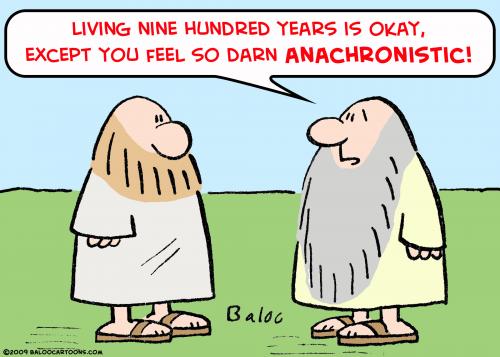
What it says to me:  At face value, chapter five is pretty straight forward:  Dudes back then were old!  Adam lived to be 930, Seth 912, Jared 962, Methuselah takes the cake at 969, etc.  Plus, these guys were having kids well past their 100s!  But if the ages are to be believed, how in the world did people live so long?  When we ask that question, things tend not to be so straight forward as we first thought.

I did a Google search for "how did people in the Bible live so long?"  With that question the flood gates open up ... literally ... the great flood and Noah's ark play a huge factor in the trend of human age.  Look below:


Age dramatically drops after Noah's ripe old age of 950 (I read ahead, it's in 9:29).  Why?  Well, going back to the search page, several answers are postulated ... nothing that can be proven, of course.  Gleaning from perusing the various web pages, here is what I think sounds the most logical.

The first humans were pretty genetically pure.  Heck, Adam had to have had the most pristine genetic code of all.  Once Adam and Eve hit the curb, well, their punishment became our normality.  Each new child began to affect our gene pool ever so slightly, but unnoticeable because people were still hitting just below 1000.  Vegetation was clean, the air was unpolluted, the earth was in its cleanest, most virginal state.

But then, like always, man is just stupid.

We make God so angry with our living that His only recourse is to flood the planet.  But lucky, holy ole Noah and his family, however are spared, giving humanity a second chance.  Once they start reforming the population again, the average age (illustrated by the individual patriarchs in the graph above; this doesn't necessarily represent the general population as far as I know) plummets over the next few names.  Why?

Life was different after the flood, to say the least.  If the waters covered the entire planet then that would certainly change the physics and chemistry of the world, that is, if God decided not to intervene in the effects.  (It seems He didn't because our old age today is only youth compared to the earliest patriarchs)  So, now we have a huge environmental, physical, chemical, traumatic change to the world that probably affects the sun, UV rays, the flora and fauna, oxygen levels, you name it!  And if Noah's family are the only one's left ... let's just say any defects were kept in the family.

Once again I take my non-scholarly stance and can't prove any of these flat-out guesses.  It sounds logical, though.

Our lives are so configured for our 70-odd years on this earth that I think I'd go nut-so if I had 900 more years to live.  It would make me regret not starting a retirement plan when I graduated from pre-school.

And in case you missed it, the patriarch Enoch (not Cain's first born, but an Enoch on Adam's side) didn't die.  "Enoch walked with God 300 years ... then he was no more, because God took him away" (22, 24).  I wonder how often God did this.  Does He do it still?  Hmm ...

Here are some sources if you're interested in some more Old-Age-Theories:

WHY did people live longer before the Flood than after it? by Arnold C. Mendez, Sr (the above graph is taken from this article.  He has some interesting mathematical reasoning; it's a short read, too)

Canopy Theory at Creationwiki

The Water Vapor Canopy Theory, Why the Bible (And Science) Says It is False, by Rich Deem

Yahoo! Answers question:  Why did people in the Bible live so long? (various answers)

Monday, April 19, 2010

Genesis 4 - Cain and Abel: A Murder Most Foul

Genesis 4


What it literally says:  Adam and Eve bear their first children, two sons who they name Cain and Abel.  Cain works "the soil," and Abel "[keeps] flocks" (2).  One day they both give an offering to the LORD and He "looked with favor on Abel ... but on Cain ... he did not look with favor" (5).  Filled with anger, Cain lures his brother out to the field and kills him.  God confronts Cain, then banishes him from the land, "marking" him so that anyone who kills him will suffer a worse curse.

Cain begins a family, the next several generations being listed.  Adam and Eve have a third son, Seth, who has a child in the future called Enosh.

And "at that time men began to call on the name of the LORD" (26).

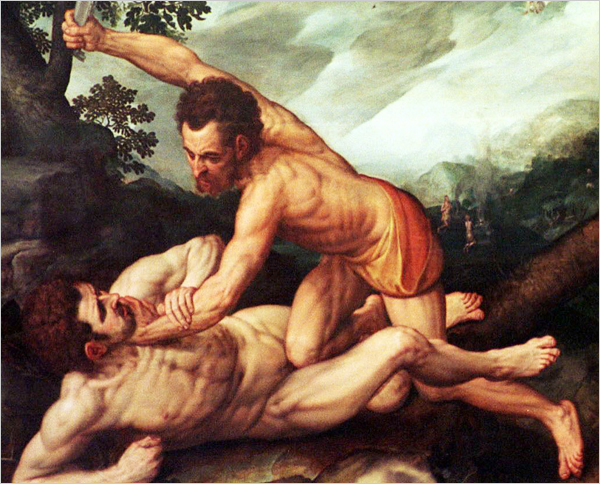
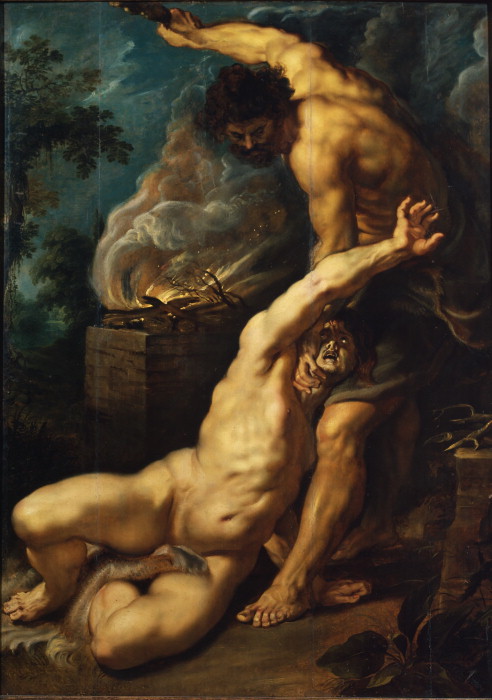
What it says to me:  We have some pretty strong disobedient acts early on in our human history, don't we?  I guess it makes sense that as new creations newly evicted into a new world, one of the first major personal revelations would be to stop completely something we don't like.  I think of a naive child when I think of Cain, not knowing that the full breadth of the consequences of his actions can have a wider effect than just on himself.  But at the same time, I think he was well aware of what he was doing, even going so far as to disguise his intent of bringing Abel into the field.  He was jealous.  He was angry.  He felt entitled, maybe, just like his mother might have felt a little entitled when she saw that the fruit wouldn't kill her but open her eyes (albeit, she didn't realize that this was a bad thing).  Who knows ... we don't even know how old Cain and Abel are (despite the above picture's depiction); at least they're old enough to work the field and shepherd a flock.  Was this murder at the hands of an angsty teenager or a plotting young adult or older?  Doesn't really matter, I think.  The act itself is the focus.

God also asks another question as if He didn't know the answer:   

Where is your brother, Abel (9)?

Cain definitely fits the teenager theory with his classic back-talk:

I don't know.  Am I my brother's keeper (9)?

I can just imagine a Cosby response.  But of course, God's sense of humor would be gravely inappropriate in this life-and-death matter.  Not only does He exile Cain, but He basically makes him live out the rest of his life as a marked man, like an offender who everyone needs to know is in the neighborhood (and who will actually give a worse punishment to anyone who kills him, "seven times over," 15).  However, God shows His unfathomable grace then just as He does today.  Cain deserves death, but instead he's let go, not off the hook, but to be gone, scarred literally and mentally.

On a lighter note, God apparently made other human beings besides the not-so-fab four!  Cain travels to the land of Nod located east of Eden.  Out of left field comes verse 17:  "Cain lay with his wife ..."  We totally jump the whole mentioning of other people, what dates Cain and Mystery Woman might have gone on, and are told flat out that Cain got 'imself married!  She must like that whole bad boy image thing.  Or Cain's ambition; he's now building a city named after their firstborn, Enoch.

With this firstborn comes the first begat ... begat family tree portions of scripture.  And dang you don't hear names like those anymore:  Mehujael, Lamech, Zillah, Tubal-Cain, et al.  I'm sure many of us have joked around at naming our current or future kids something crazy like Irad or Methushael, but coming up with a name inspired by one of these would be pretty stinking cool and unique (but, Abby, I know we won't be doing that, I'm just making conversation).

After everything, though, occurs a very interesting coincidence.  Cain and his wife's first child is named Enoch.  Adam and Eve have another son, Seth, who has a son himself named Enosh.

Enoch ... Enosh.

Looks like the fruit doesn't fall too far from the tree of Knowledge of Good and Evil.

Finally what caught my eye this morning was the unembellished last verse that says "At that time men began to call on the name of the LORD."  Was this the beginning of "religion?"  I honestly have no idea what this means but men were beginning to call on God ... for help?  For guidance?  For provision?  To praise?  Whatever it means, that one verse rings with poignancy as the infancy of our collective need for God.

Well, only 1,185 more chapters to go!

Friday, April 16, 2010

Genesis 3 - The Fall of Man

Genesis 3


What it literally says - The woman is tempted by a serpent (or "the" serpent) to eat from the forbidden tree.  She does and shares the fruit with the man.  They then become ashamed of their nakedness and of their disobedience so they hide themselves with fig leaves and from God, who they hear walking through the garden.

God discovers what they've done, cursing the serpent, woman and man with harsher living.  Man and woman are then banished from the garden, which is now guarded by "cherubim and a flaming sword flashing back and forth to guard the way to the tree of life" (24).

What it says to me - There are a few things that sunk in more deeply today!

I had forgotten how crafty the serpent is, and it's exactly how Satan still acts.  Old Deluder's strength is persuasion in the most appealing ways, to influence, to tempt but not committing actual sins himself.  Of course what he's doing is wrong, causing someone to intentionally stumble, but slyly he always takes the indirect route by strongly suggesting the option of sinning because either we deserve it, or that what God says won't actually happen, or any number of ways to twist His Word (as evidenced sickeningly in his temptation of Jesus).  Actual demon possession aside, this is most often how "the serpent" works.  The best example here is him saying in verse 4 that she won't die from eating the fruit, or at least not immediately; death does come and Man's existence becomes limited.  The devil happens not to mention a lot of things, too, like consequences for example.

(Sidenote - The above picture, by Michelangelo, is interesting because of the serpent's shape that coils up into the form of a man, maybe Lucifer?  I've seen a couple other artistic interpretations like that.)

Oh, how many times I've blamed Adam and Eve for the troubles I've encountered, rubbing my hand through my hair and screaming "Adam!" a la Marlon Brando.  It's easy to blame them, but then I think I'm just like them!

God:  Have you eaten from the tree that I commanded you not to eat from?
Adam:  Um ... *wide eyes, darting around* that woman you put here with me, um ... she, she, uh gave it to me, so ...
God:  Is this true, Eve?
Eve:  Yes, but ... I never would have thought about it if that (points finger with hand still gripping the fruit) serpent hadn't suggested it!  He lied to me!

It's so easy to pass the blame and I'm realizing how more I'm doing it as I grow older.  We're ultimately responsible for our own actions, no matter how strongly we may be influenced or "deceived."  Isn't it interesting, too, that even though God questions them He probably already knew what had happened?  Why does He still ask them?  God always allows the choice to obey or not, to confess or not; He isn't surprised by or unaware of anything.  It's our sinful and choose-able nature that bites us in the butt a lot, I think, not always "the serpent" (but I'm sure he loves it when we stumble).

We also have the earliest mention of Jesus in Scripture!  Verse15b, God to the serpent:  "he will crush your head, and you will strike his heel."  I think I heard somewhere at sometime that this was a reference to Jesus, one of those double-meaning poetic writings.

Verse 21 seemed to have been written for the first time this morning because I don't remember it!  Before Adam and Eve leave the garden, God "made garments of skin for Adam and his wife and clothed them."  God makes them clothes!  He's caring and just, knowing our needs in every situation, even in ones He never wanted us in.  Man had to be banished, but God didn't stay hanging out in Eden to leave him wandering alone.  He's everywhere.

I never really thought about God's love and care in these first three chapters as much as I have this week.  Usually I read them as historical or mythological stories, but you can still find God's personality amidst the dramatic shift from Man's being in paradise to struggling for it.

Also, if we want to find the Garden of Eden, all we need to look for is cherubim and a flaming sword (24) ... shouldn't be too hard to miss ...

Thursday, April 15, 2010

Genesis 2 - Jurassic Park Without All the Killing ... Yet.

Genesis 2

What it literally says - After creating everything, God rests on the seventh day, making it holy.

The creation of Man is then told in a little bit more detail, how God created him from the "dust of the ground and breathed into his nostrils the breath of life" (7).  God places man in the Garden of Eden, situated in "the east" and amidst four rivers, and home to the infamous trees of "Life" and of "the Knowledge of Good and Evil," the latter of which God tells the man not to eat from or he "will surely die" (17).

Man names all the animals, then God sees that He needs to create another creature to be with the man, a helper.  God, taking and working with a rib from the man's side, creates this helper, who man names "woman."  Man and woman are to be united, and at that point in history, being naked was all right.

What is says to me - The literal translation controversy continues smoothly from chapter 1.  I believe that such a garden existed.  I mean, have you ever been in a beautifully made garden or park?  A national reserve?  Being surrounded by the giant wows of nature is one of the most satisfying, humbling and relaxing feelings the human brain can experience!  Well, I guess unless you're being chased by a swarm of bees, ants, or some bears.  But I love being surrounded by nature.  I love being in it.  The fresh oxygen, the pretty scenery, the wondrous formations, the soft rustling of flora in the wind ... not much can beat the natural world when you get the chance to be there.  It's heaven on Earth.  So, yeah, to me it makes natural sense (pun intended) that God would make His first dwelling place in the midst of nature.

If I remember correctly from college, I think this is considered the "second Creation story" or something like that because of the the discrepancy of the timing of when man was formed.  In chapter 1, God made man on day six after everything else.  But verses 4b - 7 say that man came before the vegetation.  Hmm ... I don't know what this means, really.  I also read somewhere, too, that Genesis might not have been completely written by the same author, Moses in this case.  Chapter 1 calls God "God," where as chapter 2 refers to Him as "LORD" (Yahweh).  Two different schools of thought?  Is the Bible tainted?  What do you think?  That's a whole other topic that we'll certainly arrive at when we get to the "God-breathed" verses.  Something to chew on in the mean time.

Now about how man was formed ... I go back to chapter 1.  I believe God can do anything   Is dust figurative?  Is this coming-from-the-dust idea an ancient way of mentioning our dead ancestors or "predecessors" or something?  In my opinion, no, because I don't believe in macroevolution; anyway this isn't the proper place to discuss this debate (perhaps the comment section?).  God had a hand in everything, just like in chapter 1, and His hand is big enough to touch the stars and caring enough to touch a grain of sand.  He made us with purpose and intentionality.  And further proof to me, we are given the chance to show and feel that love He made us with by the existence of the opposite sex!  We can love God and love someone else.  Spread the love!  He's creative like that.

And also note that creation ended with woman ... that's how important the "weaker" sex is; God's final jewel in the crown of creation was woman (read Captivating, everyone).  Think about it.

Like yesterday, I see God's meticulous hand in the fact of existence.  That's what I get today.

Wednesday, April 14, 2010

Genesis 1 - In the Beginning ...

Genesis 1

I think everyone has probably read the Bible's initial chapters many times before.  The Creation is always a controversial topic both outside and inside of the church.

What it literally says - God created life.  In six days He formed everything that we know of existence with just His words.  The chapter lines out the first six days and what God did in each.

Day 1:  God created light, naming what is "day" and what is "night."
Day 2:  God created and named the "sky."
Day 3:  God created and named the "land," the "sea," and vegetation.
Day 4:  God created and placed the stars, the sun and the moon, giving them their "governing" abilities.
Day 5:  God created aquatic life and birds.
Day 6:  God created land-dwelling animals and human beings; we are made in His ("Our") image and given dominion over everything.

What it says to me - The Creation is so full of amazing and interesting things.  Did it take a literal six days, or is this simply a poetic gist?  If we believe God can do anything, he could have done all this in one day if He wanted, why six?  Does the Big Bang theory disprove this "something from nothing" concept?  And what does it mean in verses 2 and 7 that the earth was "formless and empty," but had deep waters, then God made waters above and below the sky?

I have no idea to any of these things.

There's a lot of the Bible that I think can be taken strictly by the way our translations have worded them.  "Love your neighbor as yourself," "Love the Lord your God with all your heart and with all your soul and with all your strength ..."  Probably a lot of the Levitical laws about dealing with dead things (can't wait to get to those!).  But Genesis 1, to me, isn't dependent on the literal details.  To me, chapter 1 paints a picture of a loving, careful, caring and creative God who crafted a purpose for every single detail about existence.  I mean, why the heck do we even exist!  Evolution may try to explain how we became the way that we are and look, but what about the predecessor to our predecessor?  And the predecessor to the predecessor of our predecessor?  Eventually you have to get back "something from nothing," and the chances of nothing making something that then happens to lead up to the unprecedented human brain and my voiceless thoughts that my fingertips are transcribing into typed words ... it's too well-designed to be by chance.

So what does Genesis 1 say to me, aside from the obvious Evolution-Creationism floor of debate?  God exists and life has a purpose.  Every single one of us has a purpose.  I hope that gives someone out there some comfort.

But I would like to know what those two waters thing means.

If you have any questions about the fiery Evolution vs. Creationism debate, I highly recommend Lee Strobel's The Case for a Creator, Jonathan Wells' Icons of Evolution, and Ben Stein's documentary Expelled, which you can actually watch in it's entirety below!